Commoditizing AI Inference with Instruments
Most teams still buy inference the same way they always have. Pick a model, wire it in, hope it stays good enough long enough to justify the work. Then a better model ships, a pricing sheet changes, or a provider quietly shifts behavior, and the whole exercise starts again.
That made sense when model quality had obvious winners. It makes far less sense now. The human preference gap between the #1 and #10 model on Chatbot Arena fell from 11.9% to 5.4% in a year, and the gap between #1 and #2 fell from 4.9% to 0.7% [1]. Quality benchmarks are saturating on a similar curve. Once the frontier compresses that much, model selection stops being the main challenge. Cost, routing discipline, and workload matching start to matter more.
That is the backdrop, and the reasoning, behind The Grid's text instruments: Text Max, Text Prime, and Text Standard. They are not model brands. Each one defines a minimum performance floor across intelligence, throughput, TTFT, context window, and output length. Any qualifying model from any qualifying supplier can serve into that instrument [3].
This is a field guide for using The Grid in production. For most teams, the right starting point is Text Prime. It is capable of handling a wide range of production workloads at a fraction of frontier cost. Text Max is the escalation tier for the genuinely hard tasks. Text Standard is the high-throughput tier where models like gpt-oss-120B bring strong tool use, function calling, and chain-of-thought reasoning at speed and volume. This guide walks through when to use each, and how to avoid overpaying.
Buying a performance tier, not a model name
Buy inference based on what the task requires, not on the name of the model serving it. The underlying model layer changes too quickly to be a stable purchase unit. Output requirements are far more durable.
The three instruments sit at distinct points on the quality, speed, and cost curve:
| Text Max | Text Prime | Text Standard | |
|---|---|---|---|
| Intelligence floor | ≥53 (AA Index) | ≥38 (AA Index) | ≥18 (AA Index) |
| Throughput | ≥30 tok/s | ≥40 tok/s | ≥100 tok/s |
| Time to first token | ≤3.5s | ≤4.62s | ≤1.32s |
| Context window | 1M tokens | ≥128K tokens | ≥128K tokens |
| Max output | 128K tokens | 30K-128K tokens | 16K-128K tokens |
| Historical price | ~$7.80/MTok | ~$0.80/MTok | ~$0.09/MTok |
Prices above are historical averages based on observed market clearing. Actual prices on The Grid are set by supply and demand and can vary roughly +/-20% from these figures [3]. For full qualification thresholds and pricing methodology, see The Grid docs [3].
Text Prime has generally been 10x cheaper than Text Max. Text Standard has generally been 9x cheaper than Text Prime. Text Max to Text Standard: 87x. The question is which parts of your system actually justify the most expensive tier. For most applications, the answer is: far fewer than you think. You do not need frontier intelligence for everything. Most of what your system does can run on a cheaper tier without any loss the user would notice.
Most AI applications are dramatically overspending on inference
Say you are spending $10,000/month on inference and routing most traffic to a frontier-tier model by default.
At Text Max pricing, that buys about 1,282 MTok per month. Now look at what a more honest routing split does to the same volume:
| Traffic share | Tier | MTok | Cost |
|---|---|---|---|
| 10% (hard requests) | Text Max | 128 MTok | ~$1,000 |
| 35% (nuanced, not frontier) | Text Prime | 449 MTok | ~$359 |
| 55% (structured, repetitive) | Text Standard | 705 MTok | ~$63 |
| Total | 1,282 MTok | ~$1,422/month |
That is an 86% cost reduction on the same token volume. Even if your Text Max share is double that, the savings are still severe. You do not need perfect routing. You need routing that is more honest than "everything goes to the smartest model."
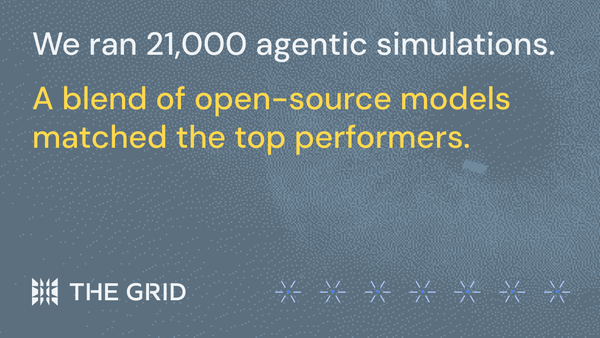
The quality tradeoff is smaller than most teams assume. We ran 21,000 simulations of tau2-bench, a multi-turn telecom and airline customer service simulation with binary pass/fail scoring, tool chaining, and 5,000-word policy docs. Text Prime, implemented as a weighted blend across six providers, scored 90.9%. The top single model (GLM-4.7) scored 97.9%. Seven points on a benchmark designed to punish brittle reasoning [2]. On most production workloads, that gap is smaller. The cost difference keeps compounding.
Text Prime is built to carry the majority of your production workload
Intelligence floor: ≥38 | Context: ≥128K | Price: ~$0.80/MTok
Text Prime is the center of gravity. If you are getting started on The Grid, this is the instrument to start with. Most applications should rely on it for the majority of meaningful work.
Text Prime sits in the production sweet spot. It is strong enough to handle nuanced reasoning, cheap enough to use at real volume, and much closer to frontier quality than the price would suggest. The tau2-bench result is the relevant data point: 90.9% on multi-turn agentic tasks with tool chaining and strict policy compliance, at 10x lower cost than Text Max [2]. That result comes from a blend of open-source models, including GLM-4.7, Kimi K2.5, DeepSeek R1, and Qwen3.5 variants, routed across providers. For the full instrument definitions and qualification floors, see The Grid docs [3].
Start on Text Prime. Move workloads down to Text Standard once you confirm they do not need Text Prime's judgment. Move workloads up to Text Max only when you can identify specific tasks where the error cost justifies it.
Customer support is a Text Prime workload
Support needs judgment, not just speed. Ambiguous phrasing, multi-part questions, context from a previous session, frustrated users who describe their problem imprecisely. Text Standard's intelligence floor starts to show on those edge cases, which account for 15-20% of real support volume.
At $0.80/MTok, a typical ticket (3K input, 500 output tokens) costs $0.0028. That is 350,000 conversations per $1,000. Text Prime is also strong enough to carry the full prompt stack that good support systems send: policy instructions, account state, retrieval snippets, conversation history, output constraints.
RAG quality is limited by retrieval, not by frontier intelligence
The bottleneck in most RAG pipelines is retrieval: wrong chunks returned, noisy context, or the source material simply does not contain the answer. Once retrieval is good, the generation task is synthesis, citation, instruction-following, and knowing when to refuse. Text Prime handles that well.
A typical RAG query (8,700 input + 800 output tokens) costs $0.0076 on Text Prime. At 100,000 queries per day: $760 on Text Prime versus $74,100 on Text Max. If retrieval quality is driving your outcomes, that premium is indefensible.
Agent loops are where pricing mistakes compound hardest
Agents do not make one call. They reason, invoke tools, read results, re-plan, and retry. At 10 LLM calls per task averaging 3,000 tokens each:
| Tier | Cost per task | Cost at 50K tasks/day |
|---|---|---|
| Text Max | $0.234 | $11,700/day |
| Text Prime | $0.024 | $1,200/day |
| Text Standard | $0.0027 | $135/day |
Text Prime scored 90.9% on tau2-bench, a multi-turn telecom and airline customer service simulation with tool chaining and 5,000-word policy docs. The top single model scored 97.9%. Most agent loops are simpler than that. For those, the seven-point gap is not worth 10x the cost per call. Text Prime handles tool result interpretation, action selection, query rewriting, and output policy enforcement well. Frontier reasoning is not the bottleneck in most agent workflows. Routing cost is.
Content generation is consistently over-upgraded
Product descriptions, email drafts, landing page variants, knowledge-base articles, report generation. These need a model that follows a brief, preserves tone, respects structure. That is Text Prime. Not Text Max.
10,000 product descriptions at 500 input + 400 output tokens each: $9 on Text Prime, $70.20 on Text Max. For templated rewriting, that premium is not justifiable.
Ambiguous, mid-complexity work belongs on Text Prime
Sentiment analysis with sarcasm. Classification with overlapping labels. Extraction from messy but not disastrous text. Compliance pre-checks before human review. Lead qualification from noisy call notes. These are not frontier problems, but they are not simple ones either. Text Prime is the right home.
Dense prompt stacks default well to Text Prime
Long system prompts, packed retrieval inserts, tool schemas, stateful conversation, explicit output constraints. When the prompt itself is doing heavy lifting even if the user-facing task is not frontier, Text Prime gives enough compliance headroom without defaulting to Text Max pricing.
Text Max is for the narrow class of tasks where correctness is non-negotiable
Intelligence floor: ≥53 | Context: 1M tokens | Price: ~$7.80/MTok
Only a small fraction of production workloads really need Text Max. The ones that do tend to share a common trait: the cost of getting the answer wrong is higher than the cost of the inference. That is the threshold worth internalizing. Not task difficulty in the abstract, but whether an error has real downstream consequences.
In practice, that means three categories: very large context where relationships span documents, multi-step reasoning with compounding dependencies, and prompt assemblies so dense that context management itself becomes the failure mode.
Multi-document reasoning cannot be faked
Building a synthesis over earnings transcripts, regulatory filings, analyst notes, and internal memos, with citations and contradictions surfaced, is not simple summarization. The hard part is holding cross-document relationships across hundreds of thousands of tokens.
Text Prime summarizes each document competently. It misses the structure of the whole. One filing softens a claim the press release states definitively. One transcript contains a caveat that changes how the rest of the set should be read. Text Max is where you route when missing that costs something real.
Threshold: corpus exceeds 200K tokens, or the downstream decision carries financial, legal, or regulatory weight.
Messy extraction requires judgment, not just parsing
Contracts that redefine terms on page 12. Medical records with inconsistent field labels. Financial statements where the important caveat is buried in a footnote. Standard extraction prompts break on all of these.
Text Max handles extraction when the model must cross-reference, resolve ambiguity, and decide what the document actually means. The stronger pattern is staged routing: let Text Prime handle clean fields, route low-confidence or ambiguous cases to Text Max. You do not need frontier intelligence for every field in every document. You need it for the fields where ambiguity creates risk.
Long reasoning chains fail gradually, then all at once
If step five depends on a nuanced interpretation from step two, compounding error is a structural risk. Debugging a complex system failure from logs. Multi-step compliance workflows with branching conditions. Architecture comparisons where every tradeoff affects the others.
Text Prime often handles individual steps fine. Text Max is the right call when the task structure itself makes compounding error likely.
Dense prompt orchestration is a Text Max problem
Some requests are not hard because the user question is hard. They are hard because the prompt assembly is hard. System instructions, tool schemas, retrieved context, working memory, previous turns, and output constraints packed into one request.
Research agents maintaining a running scratchpad plus a large corpus. Compliance copilots holding fixed policy against user-uploaded documents. These fail on context management before they fail on raw intelligence. Text Max handles that density better.
Route to Text Max by exception, not by default
87x more expensive than Text Standard. 10x more expensive than Text Prime. If you are routing classification, templated extraction, or support triage to Text Max, you are wasting budget. The right discipline: start on Text Prime, and only escalate to Text Max when you can name the specific failure mode that justifies it.
Text Standard is purpose-built for high-volume, low-ambiguity work
Intelligence floor: ≥18 | Throughput: ≥100 tok/s | TTFT: ≤1.32s | Price: ~$0.09/MTok
Text Standard's throughput is 2.5x higher than Text Prime and its TTFT is under 1.32 seconds. It is not a downgraded model. It is a different instrument, built for a specific class of work: tasks where the input is structured, the output is constrained, and volume is high. When a workload fits that description, Text Standard is not the compromise. It is the right answer.
Once you are running on Text Prime as your default, the next optimization is identifying which Text Prime workloads can move to Text Standard without quality loss. That share is usually larger than teams expect.
High-volume classification has no business running on frontier models
Ticket routing, intent tagging, sentiment classification, moderation triage, spam detection, taxonomy assignment, policy labeling. Narrow inputs. Constrained outputs. High volume.
200,000 support tickets per day at ~350 tokens each: $6.30/day on Text Standard, $56 on Text Prime, $546 on Text Max. A well-prompted classification task does not extract more value from a frontier model. It just costs more.
Cheap, fast triage is one of the highest-leverage patterns you can build
Use Text Standard as the first step in a request pipeline: classify the incoming query as SIMPLE, MODERATE, or COMPLEX, then route it to the right tier.
Classify query -> SIMPLE / MODERATE / COMPLEX
SIMPLE -> Text Standard
MODERATE -> Text Prime
COMPLEX -> Text Max
One fast, cheap call changes where every downstream dollar gets spent. This applies to support queues, agent orchestration, extraction pipelines, and RAG systems. Text Standard decides whether to answer directly, escalate, retrieve more context, or hand off, before any expensive call is made.
Structured transformation belongs on Text Standard
Parse logs. Normalize records. Reformat fields. Extract values from well-formatted templates. Convert predictable input into structured output. Convert raw traces into standardized incident events. None of this requires frontier reasoning. It requires throughput and reliability.
Run Text Standard before your expensive call, not instead of it
Summarize a long chat history into a compact state bundle before passing it to Text Prime. Compress a large retrieved corpus into a tight evidence pack. Strip irrelevant fields from a record. Normalize messy user input before it reaches Text Max.
That preprocessing step often improves the quality of the downstream Text Prime or Text Max call while cutting total cost. Text Standard is cheap enough that this pattern pays off consistently.
Synthetic and evaluation data tasks belong on Text Standard
100,000 prompt-response pairs for an eval suite costs $9 on Text Standard. Adversarial edge cases, test fixtures, prompt variations, seeded staging data. All of these feel expensive at higher tiers and routine at Text Standard. Better evaluation infrastructure pays back more than the generation job costs.
Routing decisions compound. Get them right early.
The question is not which model you prefer. It is what kind of cognitive work the request is actually asking for.
Routing heuristic:
- Start on Text Prime as the default for all meaningful workloads.
- Identify workloads that are narrow, structured, repetitive, or transformational. Move those to Text Standard.
- Identify requests with long reasoning chains, very large context, or high error cost. Escalate those to Text Max.
- If the prompt itself is doing heavy lifting (policies, retrieval, memory, tool schemas), keep it on Text Prime or Text Max even if the user query sounds simple.
A healthy production distribution tends to look like 5-10% Text Max, 25-35% Text Prime, 55-70% Text Standard. But the path there starts with Text Prime as the default, then moving workloads down or up based on evidence.
Treating instruments like abstraction layers is how you ship reliably
The core objection to instruments is reasonable: if the underlying models can change, how do you trust the abstraction? The same way you trust any abstraction layer: with a clear contract, measurements against that contract, and zero dependence on undocumented behavior.
Prompt for outputs, not personalities. If your prompt depends on a specific model's quirks, it breaks when the model changes. That brittleness already exists with direct providers. Prompt for what you want, enforce it with schema, test across models.
Use structured outputs aggressively. All three instruments support function calling and structured outputs. Once the task has a schema, variation across qualifying models drops sharply. If a response fails schema validation, retry or escalate rather than silently propagating bad output.
Build evals before you ship. Not generic benchmarks. Representative inputs from your actual workload scored against your real failure modes. Run the eval across tiers. Most teams find Text Prime is enough where they assumed they needed Text Max. That finding saves real money.
Make tier-switching a config change. Map workload classes to instruments in configuration, not hardcoded endpoint strings. Log which instrument served each request. If switching tiers requires a code change, it will not get optimized.
Monitor per route, not globally. Track cost, quality, and latency by workload class. That is how you know whether a route can move down a tier, whether a gray-zone workload needs to move up, and whether the economics are actually playing out.
You are not buying a model. You are buying a performance contract. The floor is public. Qualification criteria are measurable. Compliance is continuous. OpenAI's deprecation page is a graveyard of endpoint names people built on. The Grid's spec is the explicit version of the abstraction you were already trusting implicitly.
For more detail on instrument specs, pricing behavior, and how these tiers are defined in practice, refer to The Grid docs [3]. For the broader argument behind why inference should be bought this way, refer to [1].
Route well and you will get more performance out of every dollar you spend on inference
- Text Max: ~$7.80/MTok
- Text Prime: ~$0.80/MTok
- Text Standard: ~$0.09/MTok
A small fraction of production workloads really do require frontier intelligence. Most do not. The rest need reliable output at the right price point for the right task.
If you route workloads honestly, with Text Prime as the default, Text Standard for high-volume structured tasks, and Text Max reserved for the tasks where getting it wrong has real consequences, you can cut inference spend by 70-90% without a meaningful hit to quality. That is not a marginal improvement. It is a structural change in what your inference budget can do.
The Grid is built to make that routing practical. Standardized performance tiers. Measurable contracts. A competitive market that keeps prices honest. The infrastructure is there. What matters now is using it with discipline. You can sign up and start using The Grid in under five minutes.
Sources
- The Birth of a New Commodity Class and a Spot Market for Inference
- We ran 21,000 agentic simulations. A blend of open-source models matched the top performers.
- The Grid Docs
- The Grid App
The Grid is the spot market for AI inference. Text Max, Text Prime, and Text Standard are live today. Try The Grid.
Changes from V1 (comment resolution log)
| # | Comment (Zane) | Where | What changed |
|---|---|---|---|
| 1 | "conventional, traditional, old fashioned? I feel like old alone doesn't read well here" | "the old way" in opening sentence | Changed to "the same way they always have." More natural, avoids the flat "old." |
| 2 | "is this more of a quality measurement or human preference? Maybe add a line about benchmaxx and saturation?" | Chatbot Arena paragraph | Reframed as "human preference gap." Added "Quality benchmarks are saturating on a similar curve." Distinguishes Arena (preference) from benchmark quality and addresses benchmark saturation. |
| 3a | "I would be careful about majority, or clarify that it's capable of handling the majority, capable of handling many" | "handles the majority of real production workloads" | Changed to "is capable of handling a wide range of production workloads." |
| 3b | "I think this kind of undersells it, maybe consider some language from the 120b release post" | Text Standard description in intro | Replaced "structured, repetitive, or transformational work" with specific capabilities: "models like gpt-oss-120B bring strong tool use, function calling, and chain-of-thought reasoning at speed and volume." |
| 4 | "'output needs to do' reads odd" | "Buy inference based on what the output needs to do" | Changed to "what the task requires." |
| 5 | "clarify with generally, or has generally been" | "Text Prime is 10x cheaper" | Changed to "has generally been 10x cheaper." Also added the "you don't need frontier for everything" framing here per comment 10. |
| 6 | "I would remove this" | "Most serious applications" | Removed "serious." Now reads "Most applications should rely on it..." |
| 7 | "tasks/problems" | "specific requests where the error cost justifies it" | Changed "requests" to "tasks." |
| 8 | "clarify tau2 telecom" | "on a hard agentic benchmark" (agent loops section) | Replaced with "on tau2-bench, a multi-turn telecom and airline customer service simulation with tool chaining and 5,000-word policy docs." Also applied to the earlier tau2-bench reference. |
| 9 | "I would rephrase this, a majority of requests will inform a customer facing decision one way or another" | "Threshold: output informs a board-level, legal, or customer-facing decision" | Rephrased to "the downstream decision carries financial, legal, or regulatory weight." Removes "customer-facing" which is too broad. |
| 10 | "This is strong, 'you don't need opus for everything' I would work this in more other places" | Staged routing paragraph in messy extraction section | Added "you don't need frontier for everything" framing in three places: (a) pricing comparison section, (b) messy extraction section, (c) agent loops section. |
| 11 | "consider tasks" | Heading: "Synthetic and evaluation data generation" | Changed to "Synthetic and evaluation data tasks." |
| 12 | "I would say something else here, maybe about the most challenging tasks or similar" | "requests where errors have real costs" in conclusion | Changed to "the tasks where getting it wrong has real consequences." |
| EM | N/A (per instructions) | 5 em dashes across the article | All removed. Replaced with commas, periods, or restructured sentences. |